In my first year of teaching, my school had parent-teacher conferences at the end of each quarter, like most schools. After the first quarter, I sent home slips in my fourth-grade students’ backpacks for their parents to sign up for a time to meet with me, just like the rest of my colleagues. I had a few parents sign up. On the day of conferences, I shared an example of student work and highlighted the progress their child had made. For students who weren’t performing on grade level, I emphasized how they should read every night and practice their math facts. I kept the conversation positive because I wanted the parents to like me.
I had no idea if this was how conferences were supposed to go. I had never been to one, and this type of meeting was not on the syllabus of any of my graduate classes. The only directions I had been given by my principal were to send home the slips the front office provided and confirm with the parent what time they selected once I got the slips back.
As I was leaving the school that night after conferences, my colleague, who taught across the hall and had several more years of teaching experience, asked, “Did you get to talk to everyone you needed to?” This caught me off guard because I hadn’t thought about who I needed to talk to. That was a completely different list of parents than the ones that I had just spent the evening talking to. I responded with something like, “No, not all of them.” And she encouraged me to reach out to the parents I needed to talk to so that we could get on the same page about how we could work together to support their child.
I took her advice. When I met with the parents of the students who needed to make a lot of progress to reach their grade-level reading goals, I fumbled through the hard conversations. The parents were so gracious. Many of them had been told that their child would eventually learn how to read if they gave them more time. But by fourth grade, they were starting to believe that maybe that day wasn’t going to come. I shared what I was doing in the classroom and how they could extend the support at home. We built a partnership, and our students made a lot of progress that year.
Maybe, like many of the parents I’ve talked to, you’ve heard some version of the advice to wait and see if your child learns to read. “Let’s give her until spring.” “Some kids just need more time.” “He’s young for his grade. He’ll catch up.” Usually, it’s coming from someone who genuinely cares about your kid, and it’s easy to believe because it sounds like a kind thing to do. It also absolves everyone involved of any responsibility to teach your child how to read. We’ve known for a while now that learning to read doesn’t happen because a child matures.
What are we waiting for, exactly?
So many parents are told a story that reading will “click” for their child. It’s as if reading is an invisible light switch that turns on in a child’s brain, and all of a sudden, the words on the page make sense. Only that’s not how reading works.
Reading depends on specific pathways in the brain. For kids who are struggling, those pathways develop through explicit, systematic instruction from a skilled teacher. In one brain-imaging study, struggling readers who got a year of that kind of instruction showed more activity in the brain areas skilled readers rely on, and it held a year later. And with that kind of help early on, one leading researcher estimates only a small fraction of children (around 2 to 6 percent) would still struggle to read words accurately.¹ If your child is struggling to learn to read, waiting to see if they’ll figure it out is harmful, because most kids won’t figure it out on their own.
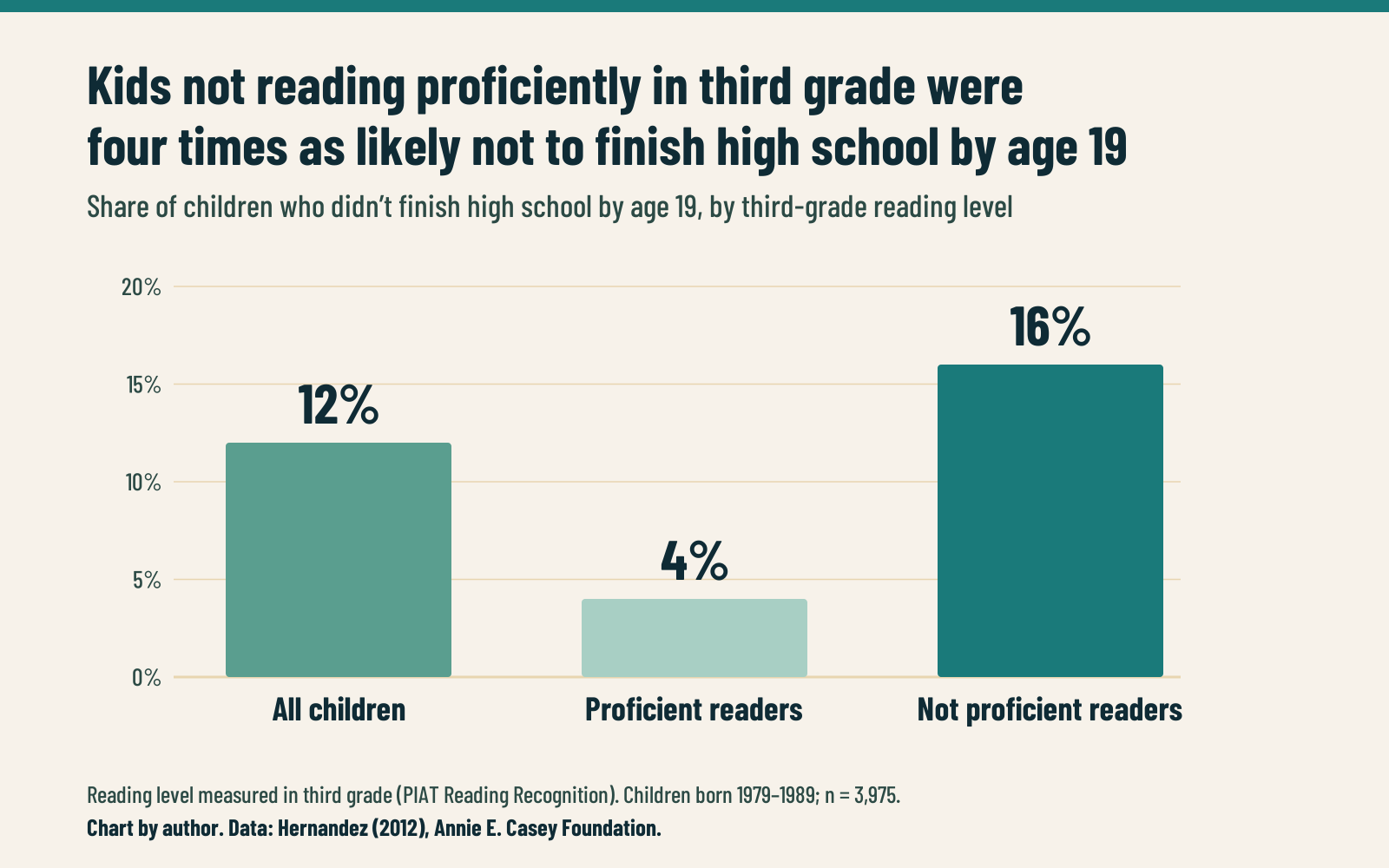
In reality, we’re waiting for the child to fail. One study followed a representative group of Connecticut kids from kindergarten all the way through 12th grade. The ones who struggled to read in the early grades showed no sign of catching up — not in ninth grade, not by the end of high school.² They weren’t late bloomers. And every one of them received special education services at some point. Most schools don’t have the staff or scheduling capacity to provide the necessary intervention their students desperately need. (Check out my post about MTSS to learn more about what intervention looks like in traditional schools.) Kids who aren’t reading proficiently by the end of third grade fail to finish high school on time at four times the rate of strong readers: 16% versus 4%.³ Can you blame them? School has been so hard for so long.
Why are parents told to wait and see?
The advice didn’t come out of nowhere. In 1940, a hugely influential physician named Arnold Gesell argued that reading depended on a child’s brain and body maturing on their own schedule. He believed many early reading problems would fix themselves if kids were given more time.⁴ That idea became known as reading readiness, and it influenced instruction in kindergarten classrooms for decades. “Don’t pressure the child to learn to read. They’ll do it when they’re ready.”
Here’s the thing: psychologist Max Coltheart spotted the flaw with this idea back in 1979, and reading researchers Jana Mason and Shobha Sinha brought it back up in 1992.⁵ Ask how a school decides a child isn’t ready to read, and the answer usually comes down to the fact that the child isn’t reading yet. So, the struggle itself becomes the evidence. If your child doesn’t read, the explanation is that they weren’t ready. Under that logic, “not ready” can never be proven wrong.
These researchers raised another point that should bother every parent. They pointed to a classroom study that found readiness thinking still shaping instruction in most kindergarten classrooms in the 1980s. They also suspected that even schools claiming newer approaches were often still running readiness programs in their classrooms.⁶
And kids who start behind usually stay behind. One classic study followed 54 children at a school in Austin, Texas, from first grade through fourth. If a child was a poor reader at the end of first grade, the chance they were still a poor reader at the end of fourth was 88%.⁷ Nearly nine in ten. They weren’t catching up on their own.
That’s one school and a small group of kids. On its own, it doesn’t prove much. But it lines up with the Connecticut study above: kids who start behind tend to stay behind unless someone steps in.
Waiting to fail has a cost.
For parents, waiting feels gentle. But when you’re seven, waiting another year to learn how to read is a very long time. That’s 180 school days: 180 mornings waking up knowing they’ll feel like a failure by lunch. Hiding it from their friends. And every day, quietly practicing the story that they just aren’t smart. Another year of believing that if they just tried harder, reading would finally click and you’d be proud of them. Waiting is far from gentle.
I shared in a previous post that each year, most of my fourth-grade students were performing two or more years below grade level in reading. Each year, I’d have students who had developed attention-seeking behaviors or habits of work avoidance because reading was hard. Up to this point in their academic journey, no one had expected my students to be able to do the work.
And it’s not just my students. As I’ve previously written, kids who struggle to read are at higher risk for anxiety, and long-term research suggests the reading struggles tend to come first.⁸ Parents carry it too. In one study of 2,752 families, parents of kids with more reading problems reported more stress, anxiety, and depression of their own.⁹
I saw this play out in my classroom and at the parent-teacher conference table. So, I spent the first couple of months of school each year building relationships with my students and their parents and proving to them each day that this year would be different. No more waiting. We picked up our books and our pencils and got to work.
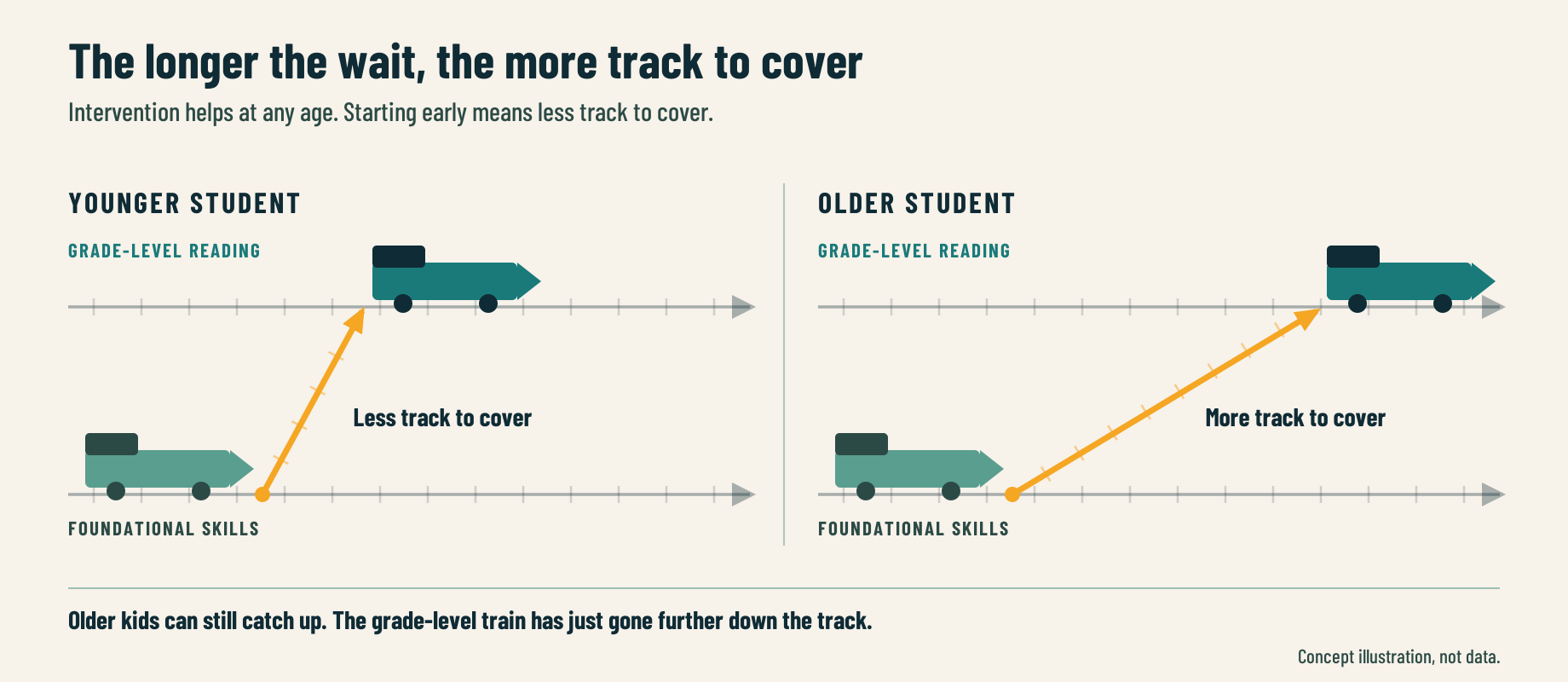
Delaying reading intervention for students who need it has more than just an emotional cost. In my experience, parents of older students spend more time and more money getting their kids to grade level. I’ve written about how foundational literacy skills such as phonics and grade-level literacy skills such as comprehension and analysis are like two trains running on parallel tracks. For an older student who is behind in reading, the foundational skills train has more track to cover to catch up to the grade-level train than it does for a younger student.
And the long-term stakes are financial too. No study has followed kids from a reading intervention all the way to their adult paychecks. But the path is well documented. Kids who read well by third grade are far more likely to finish high school on time.³ And adults who read well earn about $13,000 a year more than adults from similar backgrounds who don’t.¹⁰
The older a student gets, the further behind they get. The longer they struggle to read, the more they believe the story that they won’t learn how to read. Older students can and do learn how to read. But parents and their teens need to know that they have a tough road ahead. Not only is the reading specialist working with the older student to reconstruct more effective neural pathways for reading, but she’s also working with the student to untangle and rewrite the story of their identity.
Intervention works. The earlier, the better.
The good news is that parents can break this pattern with intervention. When researchers pooled 25 studies of intensive reading intervention in kindergarten through third grade, kids who got the intervention made reliably bigger gains than kids in the comparison groups.¹¹ Every study in the review ran 100 or more sessions, and the interventions had a lot in common: structured, explicit lessons in phonological awareness, phonics, and fluency.
In one study, struggling readers got the same intervention, an hour a day for about 125 hours, in first, second, or third grade. Three in four of the first graders ended up reading words in the average range. For the third graders, it was about one in five.¹²
That doesn’t mean older kids can’t catch up. In another study, 8- to 10-year-olds with severe reading disabilities got intensive one-on-one help, twice a day for eight weeks. On average, their reading accuracy and their comprehension of short passages reached the average range, and the gains held two years later. Within a year, 40% no longer needed special education.13 Their reading speed more than doubled. But compared to kids their age, they were still about as far behind in speed as when they started. The researchers’ best guess is that years of missed reading practice are part of the reason. In their earlier work with younger kids, that speed gap didn’t show up.
Another study gave struggling fourth graders either one or two years of small-group intervention. Kids who got two years improved faster in word reading and fluency than kids who got one. But neither closed the gap in comprehension, and the researchers suspect kids this age may need longer, more intensive help than has been studied so far.¹⁴
And starting early isn’t a one-time fix. In a three-year study, kids who got strong, individualized reading instruction in their classrooms every year from first through third grade ended up well ahead of kids who got it for just one year, even when that one year was first grade.¹⁵
Now what?
You may have recently attended a parent-teacher conference where your child’s teacher suggested you wait and see if your child improves in the next quarter before providing any additional support for reading. From where I’m sitting, you learned two things from the teacher. First, she agrees that your child isn’t meeting grade-level expectations for reading. Second, she’s planning to wait and see if your child figures it out.
You do not have to wait for your child to fail. I’d encourage you to get more information about your child’s reading skills so that you can create a plan to get them on track.
Here are some questions you can ask your child’s teacher to learn more about your child’s reading skills.
- Can you provide me with a recent reading assessment? In what areas did my child meet expectations? In what areas do they need more support?
- What reading skills has my child made progress in since the beginning of the year? What assessments do you have that show this progress?
- What is the plan if my child isn’t on grade level by next quarter? What would we need to see by then, and what happens if we don’t?
If you don’t get clear answers, or if you’d like to have a conversation with a literacy expert, request a free consultation with ClearCode Reading. We’ll walk you through our initial assessment process and create a plan to get your child on track in reading.
Endnotes
- Shaywitz, B. A., Shaywitz, S. E., Blachman, B. A., et al. (2004). Development of left occipitotemporal systems for skilled reading in children after a phonologically-based intervention. Biological Psychiatry, 55(9), 926–933. https://doi.org/10.1016/j.biopsych.2003.12.019. 77 children ages 6–9; 37 received daily one-on-one explicit, systematic tutoring for a school year. Small sample, and the research team overlaps with notes 2 and 14. Torgesen, J. K. (2004). Avoiding the devastating downward spiral: The evidence that early intervention prevents reading failure. American Educator, 28(3), 6–19. https://www.aft.org/ae/fall2004/torgesen. His estimate draws on six early intervention studies: if at-risk K–2 students received explicit, systematic intervention, 2–6% of children with IQs in the broadly normal range would still have weak word-reading skills. It’s an estimate, not a direct count, and covers word reading, not comprehension. It’s a review article, not a peer-reviewed study, and draws partly on Torgesen’s own research (see note 13). For a parent-friendly account of the brain research, see Shaywitz, S., & Shaywitz, J. (2020). Overcoming Dyslexia (2nd ed.). Knopf.
- Shaywitz, S. E., Fletcher, J. M., Holahan, J. M., Shneider, A. E., Marchione, K. E., Stuebing, K. K., Francis, D. J., Pugh, K. R., & Shaywitz, B. A. (1999). Persistence of dyslexia: The Connecticut Longitudinal Study at adolescence. Pediatrics, 104(6), 1351–1359. https://doi.org/10.1542/peds.104.6.1351. Representative cohort of 445 children entering Connecticut public kindergarten in 1983; 21 persistently poor readers and 74 comparison readers were assessed in grade 9. English-primary children only. The struggling readers had lower family income and IQ than the comparison groups. All 21 received special education at some point, which the authors describe as eclectic, inconsistent, and relatively brief.
- Hernandez, D. J. (2012). Double jeopardy: How third-grade reading skills and poverty influence high school graduation. Annie E. Casey Foundation. https://www.aecf.org/resources/double-jeopardy. n = 3,975 children born 1979–1989 (National Longitudinal Survey of Youth). “Proficient” means the top third on the PIAT Reading Recognition test, grouped to roughly match NAEP levels. The outcome is high school completion by age 19; the data don’t show whether students dropped out. Poverty compounds the risk: 26% of non-proficient readers who had experienced poverty didn’t finish on time, and 35% of those who also lived in a high-poverty neighborhood. The Annie E. Casey Foundation describes its mission as fostering public policy as well as supporting research.
- Gesell, A. (1940). The First Five Years of Life: A Guide to the Study of the Preschool Child. Harper & Bros., pp. 312–313. As quoted in Mason & Sinha (1992), p. 3.
- Mason, J. M., & Sinha, S. (1992). Emerging Literacy in the Early Childhood Years: Applying a Vygotskian Model of Learning and Development (Technical Report No. 561). Center for the Study of Reading, University of Illinois at Urbana-Champaign. ERIC ED 348 667. https://eric.ed.gov/?id=ED348667. This is a theoretical review, not new data. The authors work from an emergent-literacy perspective and favor “mediated” learning over direct instruction. The circular-reasoning critique comes from Coltheart (1979), as summarized by Mason & Sinha (1992), p. 5.
- Mason & Sinha (1992), p. 4. The classroom study they cite is Durkin, D. (1987). A classroom-observation study of reading instruction in kindergarten. Early Childhood Research Quarterly, 2, 275–300. The point about schools still running readiness programs is the authors’ own impression (“we have reason to believe”), not a study finding.
- Juel, C. (1988). Learning to read and write: A longitudinal study of 54 children from first through fourth grades. Journal of Educational Psychology, 80(4), 437–447. https://doi.org/10.1037/0022-0663.80.4.437. n = 54 children at one low-income neighborhood school in Austin, Texas (129 started first grade; many families moved). The children received regular classroom reading instruction, including a district phonics program in first and second grade. The .88 probability (21 of 24 poor first-grade readers) appears in the abstract and results.
- Francis, D. A., Caruana, N., Hudson, J. L., & McArthur, G. M. (2019). The association between poor reading and internalising problems: A systematic review and meta-analysis. Clinical Psychology Review, 67, 45–60. https://doi.org/10.1016/j.cpr.2018.09.002. McArthur, G., Badcock, N., Castles, A., & Robidoux, S. (2022). Tracking the relations between children’s reading and emotional health across time: Evidence from four large longitudinal studies. Reading Research Quarterly, 57(2), 555–585. https://doi.org/10.1002/rrq.426. Four longitudinal databases (UK, two US, Australia; combined n ≈ 23,800): emotional health at age 5 was unrelated to reading at 7, while reading at 7 was related to emotional health at 9 and 11. The authors call this a working hypothesis; the mechanisms are unknown.
- Lu, X., Zhu, K., Wang, H., Xiang, Z., Zhao, S., Liu, R., Tang, J., & Song, R. (2026). The effect of reading problems on emotional and behavioral problems in children: The chain mediating role of parenting stress and parental anxiety/depressive symptoms. BMC Psychiatry, 26, 146. https://doi.org/10.1186/s12888-026-07778-8. n = 2,752 children in grades 2–6 in Wuhan, China. All measures were parent-reported, including reading; effects were small; the authors make no causal claims. Why this post doesn’t claim reading problems cause behavior problems: the evidence is mixed. Lu et al. found small associations with conduct problems in parent reports, while Shaywitz et al. (note 2) found no differences in conduct, attention, or legal trouble at grade 12.
- Rothwell, J. (2020). Assessing the economic gains of eradicating illiteracy nationally and regionally in the United States. Gallup, for the Barbara Bush Foundation for Family Literacy. https://www.barbarabush.org/wp-content/uploads/2020/09/BBFoundation_GainsFromEradicatingIlliteracy_9_8.pdf. Adults ages 16–74, using PIAAC literacy levels. The $13,193 figure compares adults at Level 2 and Level 3 (the minimum for proficiency), adjusted for age, gender, race, nativity, parents’ education, and childhood books in the home. Adjusting for educational attainment as well shrinks the gap to $7,786, since part of literacy’s payoff runs through finishing school. The study measures adults at one point in time; it doesn’t follow children. The Barbara Bush Foundation does advocacy as well as research.
- Wanzek, J., Stevens, E. A., Williams, K. J., Scammacca, N., Vaughn, S., & Sargent, K. (2018). Current evidence on the effects of intensive early reading interventions. Journal of Learning Disabilities, 51(6), 612–624. https://doi.org/10.1177/0022219418775110. Meta-analysis of 25 studies in grades K–3 with 100 or more sessions; mean effect size 0.39 (0.28 after adjusting for publication bias). Most studies were in kindergarten and first grade.
- Lovett, M. W., Frijters, J. C., Wolf, M., Steinbach, K. A., Sevcik, R. A., & Morris, R. D. (2017). Early intervention for children at risk for reading disabilities: The impact of grade at intervention and individual differences on intervention outcomes. Journal of Educational Psychology, 109(7), 889–914. https://doi.org/10.1037/edu0000181. Quasi-experimental; 172 intervention and 47 control children in Atlanta, Boston, and Toronto; groups of four, an hour a day. “Average range” means a standard score above 90 on Word Identification (76.3% in grade 1, 21.3% in grade 3). Grade made no difference on the comprehension tests, and spelling favored third graders. The program’s developers were co-authors.
- Torgesen, J. K., Alexander, A. W., Wagner, R. K., Rashotte, C. A., Voeller, K. K. S., & Conway, T. (2001). Intensive remedial instruction for children with severe reading disabilities: Immediate and long-term outcomes from two instructional approaches. Journal of Learning Disabilities, 34(1), 33–58. https://doi.org/10.1177/002221940103400104. n = 60 Florida children ages 8–10 already identified as learning disabled, randomly assigned to two methods; 67.5 hours of one-on-one instruction from highly experienced teachers; no untreated control group. About a third still scored below average in decoding at the two-year follow-up. The district reported a typical special-education exit rate of 5% for comparison. The explanation for the speed gap is the authors’ hypothesis.
- Miciak, J., Roberts, G., Taylor, W. P., Solis, M., Ahmed, Y., Vaughn, S., & Fletcher, J. M. (2018). The effects of one versus two years of intensive reading intervention implemented with late elementary struggling readers. Learning Disabilities Research & Practice, 33(1), 24–36. https://doi.org/10.1111/ldrp.12159. Randomized; n = 484 fourth graders; groups of 4–6, 30–40 minutes a day for about 16 weeks a year. The comparison group also averaged more than 50 hours of school-provided intervention, which narrowed the contrast. The “longer, more intensive” line is the authors’ tentative interpretation.
- Connor, C. M., Morrison, F. J., Fishman, B., Crowe, E. C., Al Otaiba, S., & Schatschneider, C. (2013). A longitudinal cluster-randomized controlled study on the accumulating effects of individualized literacy instruction on students’ reading from first through third grade. Psychological Science, 24(8), 1408–1419. https://doi.org/10.1177/0956797612472204. Whole-class differentiated instruction, not pull-out intervention; North Florida schools, 47% free or reduced-price lunch, 81% White; uses software developed by the research team.