What can I expect from a reading tutor?
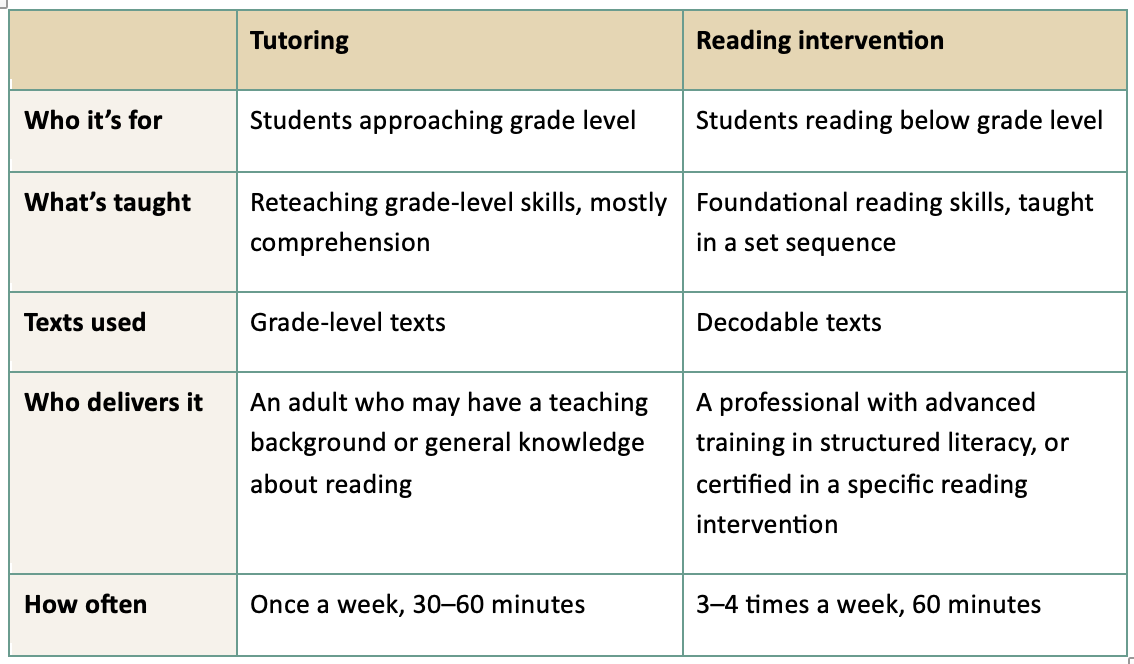
Typically, private tutoring is one-on-one support with grade-level reading skills provided by an adult who may have a background in teaching or general knowledge about reading skills. The type of support a tutor provides is generally reteaching grade-level skills using grade-level texts. Tutoring typically happens once a week for 30 minutes to an hour, but you can adjust the frequency depending on the tutor’s flexibility.In grades K–2, this could mean that tutors are working on phonics or it could mean that they are working on comprehension. Both Common Core and Florida’s B.E.S.T. standards put the skills that actually teach the code — letter sounds, digraphs, vowel teams, syllable types — in kindergarten through second grade. In these grades, foundational skills are part of the grade-level curriculum.¹ Typically, though, foundational skills instruction requires more specialized training that a tutor would not necessarily have.
Usually, tutors focus on comprehension, or supporting students with understanding what the text is about. You could expect a tutor to share a comprehension strategy with your child, like summarizing. They may show them the steps for summarizing and provide a graphic organizer. The tutor and your child may take turns reading a few pages aloud, and then your child may read the rest of the text or chapter independently. During reading the tutor may pause and ask your child questions to check if they understood what they read.
If your child isn’t comprehending the text, the tutor may ask them go back and reread a part of the text so that they get back on track. One of the goals of tutoring is to get your child to notice when they do not understand what’s happening in a text and use a strategy to repair their understanding. Summarizing a section or using context clues to figure out the meaning of unfamiliar words are common repair strategies.
At the end, the tutor may guide your child through the steps for summarizing. After a few sessions of working on summarizing, your child may use that strategy while they’re reading texts in school or somewhere else. Once your child shows they can summarize texts on their own, the tutor may repeat this process with a different comprehension strategy.
Does tutoring work?
It depends. Most of the tutoring research that gets cited studies school-based programs, so the private, once-a-week model has thin evidence either way.²We do know the conditions that a tutoring relationship needs to be successful. First, the tutor needs to be skilled in teaching the grade-level concepts that the child needs support with. If I were hiring a private tutor, I’d ask for their credentials. I want to know if they have experience teaching the grade-level or a similar grade-level as my kid. If I were looking at a tutoring center, I’d ask about the credential requirements and the training tutors receive. I want to know if their tutors have degrees in education, if they’ve taught the subject my child will get tutoring in, and if they are trained to use a specific curriculum. The last question I would ask is about effectiveness. I’d want to know what progress I can expect to see from my child over a certain period of time. Tutoring should not be an indefinite agreement or financial commitment.
The tutor needs to use assessment data to determine what the child should work on. They need to continue to use informal assessments so they can decide whether to adjust their approach or progress to a new skill.
Your child’s motivation also play a role in the success of tutoring. If your child feels supported by the tutor and likes the topic they are reading about, they can be more engaged during tutoring. This helps them get the most out of the session. As you look for a tutor, you’ll want to see how they interact with your child to gauge if their personality and instructional approach are a good fit.
Frequency is also something to consider. Meeting more often can positively impact your child’s progress.³
What is reading intervention and how is it different from tutoring?
If your child is reading below grade level, reading intervention may be a better fit.Typically, private reading intervention is one-on-one support with foundational reading skills. Instruction is provided by a professional who has advanced training in structured literacy or is certified in a specific reading intervention. I look for 60-minute sessions, at least three to four times a week.⁴
Specialists typically follow a research-backed program that provides explicit, systematic, and sequential foundational skills instruction. There are different programs designed for specific age-groups. If your child is in upper elementary or middle school, you’ll want them learning with texts and materials that are age-appropriate and don’t come across as “babyish.” So, if the reading specialist says that the intervention can be used for grades K–5, ask how the fifth-grade texts and materials are different from the second-grade texts. If they are the same, consider how your child will feel about being handed them.
Reading interventions follow a specific sequence, so that concepts build on each other. For example, closed syllables with short vowels like bat, pet, and rug, are taught before vowel teams with long vowels like boat, steep, and rain. The specialist will assess your child to determine where they will start in the sequence.
You could expect the reading specialist to introduce one concept at a time to your child. Each time a concept is introduced, the specialist explains the syllable type and provides examples. Students practice building, reading, and spelling words with the new concept while the specialist provides support in the moment. The session usually ends with the specialist and the child applying the new concept in a controlled text, or a text that only includes words with the concepts your child has been taught. Reading text your child can decode accurately builds automatic word recognition. Because students spend less cognitive energy sounding out words, they begin to read in phrases instead of word by word. This kind of practice reliably improves fluency. It helps comprehension too, but less.⁵
Specialists also take notes during the session so that they can review concepts that your child needs additional practice with. For example, if your child mixes up short i and short e, the specialist will use words in the next session that include more practice with both. Typically, a specialist would spend a few sessions on the same concept and informally assess your child to decide if they are ready to progress to the next concept.
If your child is reading below grade level in grades K–2, you’ll want to ask their teacher if they need additional support in foundational skills, like sounding out words, or comprehension, understanding what they just read. This is because in K–2 the grade-level curriculum includes foundational skills and content standards. From third grade on, the standards assume your child already has the foundational skills and move on to roots, prefixes, and long words. Nothing in the grade-level curriculum goes back to teach it, and a decoding gap also does not quietly resolve itself. In one large study of fifth through tenth graders, students whose decoding fell below a certain point made almost no progress in reading comprehension over the next three years, while their classmates kept gaining.⁶ That is why, if your child is reading below grade level, especially in grade 3 and up, reading intervention could be a good fit.
Does reading intervention work?
Under the right conditions, yes. Reading interventions that teach foundational skills produce real gains for struggling readers, and the more hours a child gets, the more progress they make.⁷ What matters most is that whoever delivers it is trained and follows the program as designed.Reading intervention should not replace grade-level instruction. If your child is getting reading intervention at a private clinic or with a certified specialist outside of school, this isn’t a concern. Schools sometimes offer reading intervention, and this is an important question to ask if you are told your child qualifies for intervention during school hours. This might sound confusing or go against your instinct. You might be thinking, If my child needs support decoding words, they need to get that support first before they can get grade-level instruction. But trading one for the other doesn’t work. A child who spends a year only on foundational skills comes back to grade-level text having missed a year of grade-level ideas.
This is because foundational reading skills and grade-level content are different. Foundational skills instruction mainly focuses on how to read words. Grade-level content focuses on understanding and working with texts. If your child needs support with foundational skills, it’s very likely impacting their ability to access grade-level texts independently. While your child is getting reading intervention with foundational skills, they should also receive support with reading grade-level texts at school. This could look like the teacher reading the text aloud, partner reading, or listening to a recording as they follow along in their text. That way, when it’s time to talk about the text, analyze its ideas, and respond in writing, they can participate.
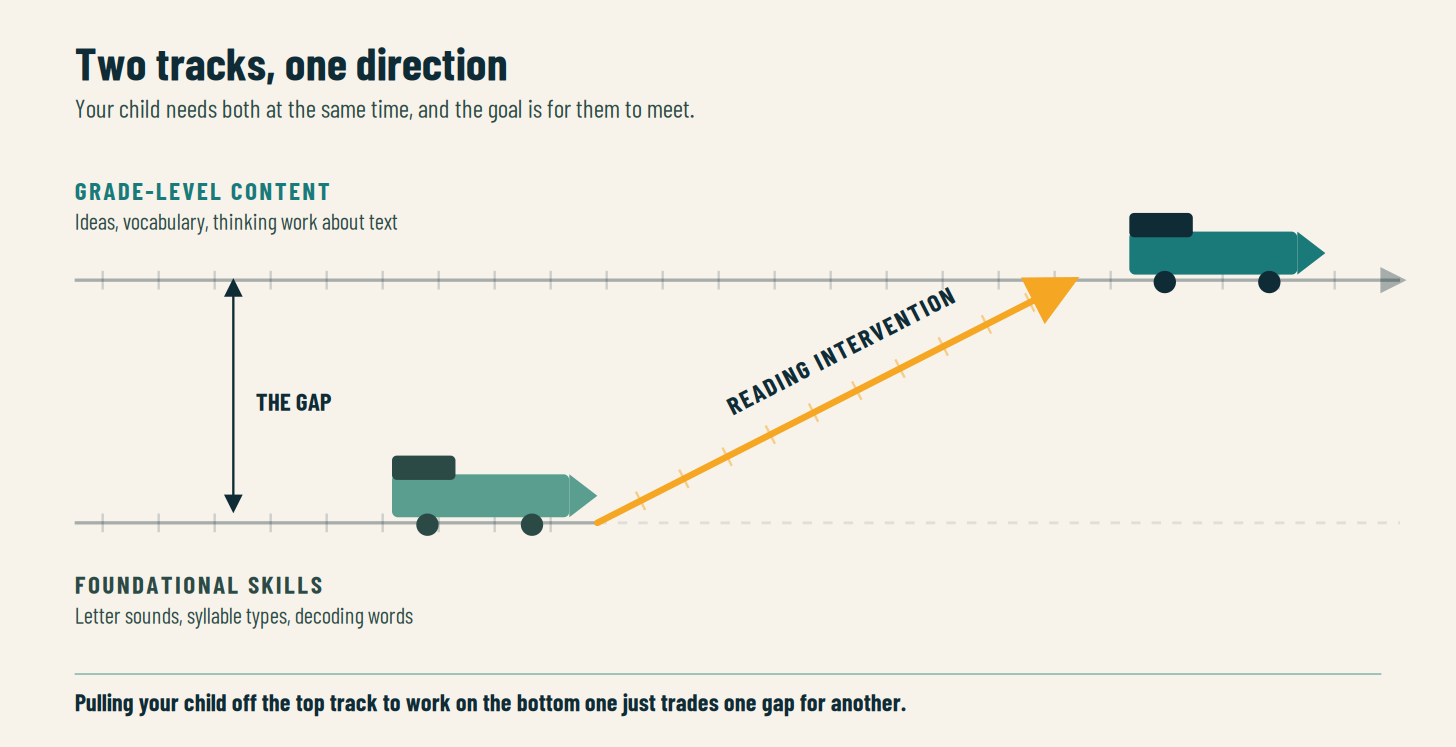
Grade-level texts expose your child to grade-level ideas and vocabulary. How did the character change? What lesson did the character learn? Why do animals have adaptations? When they have access to grade-level text, your child can do the grade-level thinking work about the text as they build their foundational skills. It’s like two trains running on separate tracks headed in the same direction, and the goal is for the foundational skills train to catch up to the grade-level train. If the grade-level train stops moving so that the foundational skills train can catch up, they will both be behind schedule.
 This has been really hard for schools to figure out. Because reading intervention needs to happen outside the literacy block at least three or four days a week to work, administrators have to find time in the schedule. And the schedule is already full. Florida elementary schools have to deliver 150 minutes of PE and 100 minutes of recess every week, which leaves almost no slack in a master schedule. There is an exception worth knowing about, though: state law waives the PE requirement for a student who is enrolled in a remedial course. So, the time can be found. It often comes out of the part of the day your child likes best.⁸ Unless the school has a dedicated time for intervention, there usually isn’t time in the schedule for reading intervention the way it’s designed to be the most effective. That's why it's important for you to get support for your child outside of school.
How can I support my child at home with reading?
If you have time and you are looking for a more budget-friendly option, you can support your child at home with reading. If you are looking to purchase a foundational skills program, look for something that is aligned to the Science of Reading and includes explicit, systematic phonics instruction. If you want to learn more about what this looks like and sounds like, browse Reading Universe’s website.⁹ They provide a sequence of skills, descriptions, instructional videos, and examples for practice and assessment.If you are looking for resources to support your child with comprehension, first, find a book they want to read. Start with books on topics that they know a lot about or are interested in learning more about. Check out a graphic novel from the library. You can sit side-by-side and take turns reading a few pages aloud. If your child is too cool for that, you could each get a copy of the book and read at the same time. When you are finished reading, talk about what your read. Here are some questions to get your conversation started.
- What happened?
- What’s the conflict? What makes you say that?
- Why did the character make that choice?
- What surprised you?
- What sentence or phrase did you think was the most interesting? Why?
- Was a new character introduced? How do you think they will change the storyline or group dynamic?
- What kind of person is the main character? Why do you think that?
- What lesson did the character learn? Why do you think that?
- What did you learn about [the topic]?
- Do you think the author was trying to inform, persuade, or entertain us? What makes you say that?
- What do you think the author wants us to know about [the topic]? What makes you say that?
- What sentence or phrase did you think was the most interesting? Why?
- What picture, diagram, or graph do you think was the most important? Why do you think that?
If you’re contacting private tutors, tutoring centers, or reading specialists for reading intervention, below are some questions you can ask to understand if it’s a good fit. This is not an exhaustive list. You can choose a few questions to jump-start your conversation.
- Tell me more about your teaching experience.
- Tell me about your process for developing a support/tutoring plan for my child.
- How many days a week do you recommend tutoring/intervention? How long is each session?
- Do you use a specific curriculum? If so, why did you choose this curriculum? If not, how do you choose instructional methods and materials?
- Tell them about your child: strengths, interests, concerns. What experience do you have with students like my child? What have you tried that’s been successful for students like them in the past?
- How will you know the tutoring/intervention is working?
- How will you communicate progress? How often?
- My goal is for my child to ________. How long could we expect for my child to need tutoring/intervention?
- What happens in a typical session?
- What expectations do you have for families and students?
Endnotes
- Common Core State Standards, Reading: Foundational Skills (RF) strand, thecorestandards.org/ELA-Literacy/RF. Florida’s B.E.S.T. Standards for English Language Arts, Foundations strand (Just Read, Florida!), Progression of Foundational Skills, pp. 11–12. Both run phonics benchmarks from kindergarten through grade 5 — not K–2 — but the content turns over at the same point in each. In Common Core, grade 2 (RF.2.3) covers long and short vowels in regularly spelled one-syllable words, additional common vowel teams, two-syllable words with long vowels, common prefixes and suffixes, and irregularly spelled words. Grade 3 (RF.3.3) shifts to prefixes and derivational suffixes, common Latin suffixes, and multisyllable words. Grades 4 and 5 (RF.4.3, RF.5.3) each state: apply combined knowledge of all letter-sound correspondences, syllabication patterns, and morphology to unfamiliar multisyllabic words in and out of context. Florida’s progression is built the same way. 2.F.1.3 covers variable vowel teams, diphthongs, open and closed syllables, consonant -le, common prefixes and suffixes, and silent letter combinations; 3.F.1.3 moves to Greek and Latin roots and derivational suffixes; and 4.F.1.3 and 5.F.1.3 share a single benchmark nearly identical in wording to RF.4.3. So, in both, the code is taught in K–2, applied in grade 3, and presumed from grade 4 on. Print concepts and phonological awareness are absent from the grade 2 standards onward in both. Common Core has no foundational skills strand at all past grade 5, while every other reading strand continues through grade 12. Florida instead maintains a separate strand, ELA.612.F.2, restoring phonological awareness, phonics, encoding, and fluency for secondary students needing reading interventions. The Florida document also notes that its Foundations benchmarks do not spiral the way benchmarks in the other strands do.
- Nickow, A., Oreopoulos, P., & Quan, V. (2024). The Promise of Tutoring for PreK–12 Learning: A Systematic Review and Meta-Analysis of the Experimental Evidence. American Educational Research Journal, 61(1), 74–107. doi:10.3102/00028312231208687. Meta-analysis of randomized tutoring field experiments; pooled effect 0.288 SD (SE = 0.029, p < .001). Effects were largest for programs using teachers or paraprofessionals as tutors, held in earlier grades, occurring at least three days per week, and held during school. The review defines tutoring as one-on-one or small-group instructional programming delivered by teachers, paraprofessionals, volunteers, or parents. Commercial tutoring centers and privately hired tutors are not categories in the sample, and every included study evaluated a structured program rather than the private market. The journal article is paywalled; this note rests on the published abstract. An earlier version circulated as NBER Working Paper 27476 (2020) reporting 0.37 SD; that figure was superseded in peer review, so the older number still in circulation is out of date.
- Nickow, Oreopoulos & Quan (2024), as above. Effect sizes were largest for programs running at least three days a week. Worth noting that this finding comes from school-based programs, not the private once-a-week model described earlier in this post.
- This is my clinical standard, not a research finding. For comparison, Curriculum Associates’ own planning guidance for Phonics for Reading asks schools to choose between 20–30 minutes (half a lesson) or 45–60 minutes (a full lesson) per day — daily, rather than three to four times a week. I could not locate published session-length or frequency guidance from IMSE for Orton-Gillingham Plus.
- Therrien, W. J. (2004). Fluency and Comprehension Gains as a Result of Repeated Reading: A Meta-Analysis. Remedial and Special Education, 25(4), 252–261. doi:10.1177/07419325040250040801. Across all evaluated studies the combined mean effect size was 0.64 (SE = 0.04) for fluency and 0.42 (SE = 0.05) for comprehension — comprehension gains run consistently smaller than fluency gains. A caution on this paper: Therrien reports results separately for rereading the same passage and for transfer to new passages, and secondary sources quote whichever pair suits them without saying which. I have seen it cited as 0.75 and 0.73, and as 0.50 and 0.25, as well as the combined figures given here. The combined figures are the ones I could verify from the article itself; the journal is paywalled and I have not read the disaggregated tables. The underlying mechanism is the automaticity theory of LaBerge, D., & Samuels, S. J. (1974), Toward a theory of automatic information processing in reading, Cognitive Psychology, 6(2), 293–323: attention spent decoding a word is attention unavailable for meaning.
- Wang, Z., Sabatini, J., O’Reilly, T., & Weeks, J. (2019). Decoding and Reading Comprehension: A Test of the Decoding Threshold Hypothesis. Journal of Educational Psychology, 111(3), 387–401. doi:10.1037/edu0000302. Two studies in one mid-sized East Coast school district. Study 1: 10,450 students in grades 5–12, identifying a threshold on the RISE word-recognition measure below which decoding and reading comprehension were essentially unrelated — a correlation of .06 below the threshold against .48 above it. Between 38 percent of fifth graders and 19 percent of tenth graders fell below it. Study 2: 34,016 students in grades 5–9 tracked across four waves over three years. Fifth graders above the threshold gained about 2.9 points of comprehension per year and their growth accelerated with each grade; fifth graders below it gained about 0.6 points per year and showed no acceleration at all. Limits, most of which the authors state themselves: the design is correlational rather than experimental, and they call for an intervention study to test it; the sample is a single high-poverty district, 86 percent African American, with more struggling readers than a nationally representative sample would have; Study 2 had high attrition; and decoding was measured with one instrument, RISE, developed by the authors’ own organization. The authors also caution that decoding intervention for a student below the threshold may not produce visible comprehension gains until the threshold is crossed, and even then only over time. The journal version is paywalled; I read the accepted author manuscript (ERIC ED586109). The study is funded by the Institute of Education Sciences.
- Hall, C., Dahl-Leonard, K., Cho, E., Solari, E. J., Capin, P., Conner, C. L., Henry, A. R., Cook, L., Hayes, L., Vargas, I., Richmond, C. L., & Kehoe, K. F. (2023). Forty Years of Reading Intervention Research for Elementary Students With or at Risk for Dyslexia: A Systematic Review and Meta-Analysis. Reading Research Quarterly, 58(2), 285–312. doi:10.1002/rrq.477. Experimental and quasi-experimental studies conducted between 1980 and 2020; 53 studies reported in 52 publications; 6,053 students in grades K–5 with or at risk for word reading difficulties. Main effect on norm-referenced reading outcomes g = 0.33, p < .001. Dosage and reading outcome domain were the only variables that significantly moderated intervention effects; grade level, instructional group size, and multisensory nature did not. The journal article is paywalled; this note rests on the published abstract, and the results tables remain unread.
- Fla. Stat. § 1003.455. Subsection (3) requires 150 minutes of physical education per week for students in kindergarten through grade 5, with at least 30 consecutive minutes on any day PE is taught. Subsection (6) requires at least 100 minutes of supervised, unstructured free-play recess per week, with at least 20 consecutive minutes per day; charter schools are exempt. Subsection (4)(a) waives the PE requirement for a student who is enrolled or required to enroll in a remedial course. The statute contains no prohibition on withholding recess for academic reasons — language to that effect appeared in a 2016 bill that did not become law.
- Reading Universe is a free platform produced by WETA/Reading Rockets, the Barksdale Reading Institute, and First Book. readinguniverse.org.