Like most schools, the leadership team at the school where I taught fourth and fifth grade ELA would have grade-level teams review their students’ beginning-of-year assessment data every September. We were supposed to identify the students that scored below the 10th percentile and recommend them for intervention. For students that scored below the 25th percentile, we were supposed to create a plan for small group instruction and identify how we would collect data on their progress. We were supposed to implement the plan to work on the prerequisite skills students were missing while collecting data on their progress for six weeks. Then, we would meet as a grade-level team six weeks later to determine if the small group instruction was working or if we needed to recommend the student for intervention. Easy peasy, right? Not exactly.
I consistently inherited a fourth-grade class where well over half of the students scored below the 25th percentile on the beginning-of-year reading assessment, and usually close to a fifth of my students scored below the 10th percentile. This was not my students’ fault. If you are nine and you can’t read, that’s not your fault. If the whole class can’t read, that’s not the new teacher’s fault. Yet, it was our reality. Unfortunately for us, I could only submit one or two students for intervention right away. Also, I could implement small group instruction with my entire class (which I did), but I could only submit one group’s data (about 5–6 students) to go through the process. That meant several of my students who desperately needed intervention didn’t get it from the interventionist at our school. So, I get why you’re frustrated. I was frustrated, too.
If you’re disappointed or frustrated by the support your child is getting at school, you’re not alone. And it would make sense if you have directed this frustration at your child’s teacher or school leader. They are in charge, right? Yes and no. They are responsible for providing your child with high-quality instruction and materials. Absolutely. And when it comes to providing support outside of grade-level expectations, your child’s school might be operating within a larger system that hasn’t set them up for success. There’s a lot more to the story.
The truth is, it wasn’t my school leaders’ fault either. They took the job knowing our school had some of the lowest test scores in the city. They literally worked miracle after miracle for our students and teachers. It’s just that my class wasn’t an outlier. Nearly every class had this makeup. We had to start somewhere. If we submitted every student who needed it for intervention, we would overwhelm the system. In my experience, effective reading intervention needs to happen every day for 30–45 minutes in addition to the literacy block, and the group size matters. You have to keep the groups to no more than 3 students. Reading interventionists also have regular teacher responsibilities like arrival, lunch or recess, and dismissal duties. So, in an ideal situation, they have about four or five 45-minute blocks for intervention each day. That’s 12 to 15 students in the entire school. If it’s a K–5 school, that’s about 2 or 3 students per grade.
So, I did the paperwork for the students that I could, and I took care of business in my room. I continued to provide high-quality grade-level instruction to my students. This meant my students got a lot of support, and they were still expected to do the grade-level work with the grade-level text. I didn’t realize it at the time, but this was the best thing I could have done for my students. All students, including struggling readers, need to do the grade-level work. Teachers should provide support, absolutely, but students need to experience the grade-level content they are being assessed on.
When teachers’ lower expectations for students because of perceived ability, students tend to rise only to those low expectations. In these situations, students continue to struggle with grade-level skills because they haven’t had practice with those skills. Researchers at TNTP followed nearly 4,000 students in five school systems and saw this play out. More than 8 in 10 teachers said they believed in grade-level standards, but fewer than half thought their own students could meet them. And kids who started the year behind made more progress in classrooms that gave them more grade-level work, not less. They made up more than seven months of ground on their classmates in a single year.¹
I also got certified in a reading intervention as part of my graduate coursework, and I became my students’ personal reading interventionist. I was fortunate that my school had a dedicated “WIN” block. WIN stands for “What I Need.” It’s a dedicated time outside of core instruction for students to get support or extension in reading or math. At my school, a popular app was used to provide personalized instruction to students during this time. So, when my students were supposed to be on the computer receiving “intervention” or “extension” from an app, I provided human-based reading intervention. And my students learned to read. Each week, I received messages from the district office about how my students were not meeting their “minutes” on the app. I stayed the course, and when my students started improving faster than the rest of their peers in other classes, the district office left me alone. We beat the odds because we worked outside the system. Not every teacher can take this risk, and not every student is lucky enough to have one who can.
What is a Multi-Tiered System of Support?
This process for identifying students who need support and deciding what type of support they get has different names at different schools, but the umbrella term is Multi-Tiered System of Support (MTSS). The tier system includes support for academics and behavior, and most schools use three tiers.
Tier 1 is effective grade-level instruction across classrooms in a school. This means teachers are provided with a high-quality curriculum aligned to standards and grounded in the Science of Reading. They explicitly teach students concepts, show them what to do, and provide guided practice with feedback. We also know that regular coaching helps. Across 60 studies, coaching improved both teachers’ instruction and students’ test scores, and programs that paired coaching with group training tended to see larger gains.²
Check out my blog post from a few weeks ago that breaks down how much states have invested in Tier 1 instruction, what worked, and what they left out.
Tier 2 instruction is targeted small group instruction in the classroom. Tier 2 instruction is typically delivered by the classroom teacher for 20–30 minutes three to five times a week.³ A Special Education or English Language Development teacher might deliver the small group instruction in the classroom. Group size varies depending on how much time the teacher has and what skills students need support with. The small groups in my classroom had anywhere from four to eight students.
In Tier 2, the teacher works with a small group on prerequisite skills students are missing so that they can access grade-level content. So, if the beginning-of-year assessment showed that some students needed more support with identifying the main idea of a text, a teacher may provide additional practice with this skill in a small group. She may start with identifying the main idea of an easier text and progress to more complex texts over several weeks. The teacher will assess students in the small group on identifying the main idea over six weeks and document their progress. Once students improve, the teacher might adjust her groupings and repeat the process of small group instruction with a different prerequisite skill.
If the students do not improve, she’ll most likely do another round of Tier 2 small group instruction before recommending them to Tier 3. That’s because one of the goals of MTSS is to prevent teachers from unnecessarily referring students to special education.⁴ Sometimes a student isn’t on grade level because they haven’t been taught the concepts, not because they have a learning disability. MTSS gives students the targeted support they need and time to learn the skills they weren’t taught.
Tier 3 is intervention. Typically, reading intervention is delivered by someone who has advanced training in teaching reading, and a certification or additional credential is often required. In this tier, students should get more intervention time than they would in Tier 2, either one on one or in a group no larger than three students.⁵
What needs to be in place for MTSS to work?
MTSS only works when a lot of people work together: school leaders, interventionists, general education teachers, special education and ELD teachers, and the school counselor.
The school leader owns the master schedule. It sets aside time for grade-level instruction and intervention, and it has to staff those blocks around special education and ELD teachers' existing caseloads.⁶ School leaders also set the testing calendar: benchmark assessments at the beginning, middle, and end of the year, plus regular progress monitoring. And they protect time for grade-level teams to review small-group data and adjust.
Classroom teachers plan grade-level and small-group instruction, track the data, and change course when something isn’t working. They also coordinate with special education and ELD teachers on IEP and ELL Plan accommodations, and with the counselor and families on behavior support.
That’s not everyone, but you get the idea. Take one piece out, and the whole thing stalls.
Does MTSS work?
Under the right conditions, yes. But the research is more mixed than most people realize, and the conditions matter a lot.
The biggest federal study of RtI (Response to Intervention, the framework MTSS grew out of) looked at 146 elementary schools across 13 states that had been running it for at least three years.⁷ For first graders who scored just below their school’s cutoff for intervention, being assigned to intervention made their reading scores slightly worse, about a tenth of a year less learning. In second and third grade, it made no statistically significant difference.
That doesn’t mean MTSS doesn’t work. The study only looked at kids right at the edge of the cutoff, not kids who were far behind, and the researchers said plainly that it doesn’t tell us whether the framework as a whole works. They also found that about two-thirds of the schools delivered at least some intervention during the core reading block. So, some kids may have been getting intervention instead of grade-level instruction, not on top of it.
Researchers see this pattern a lot. A program works when researchers run it closely, and then the results shrink or disappear once schools run it on their own.⁸
What are common obstacles to MTSS?
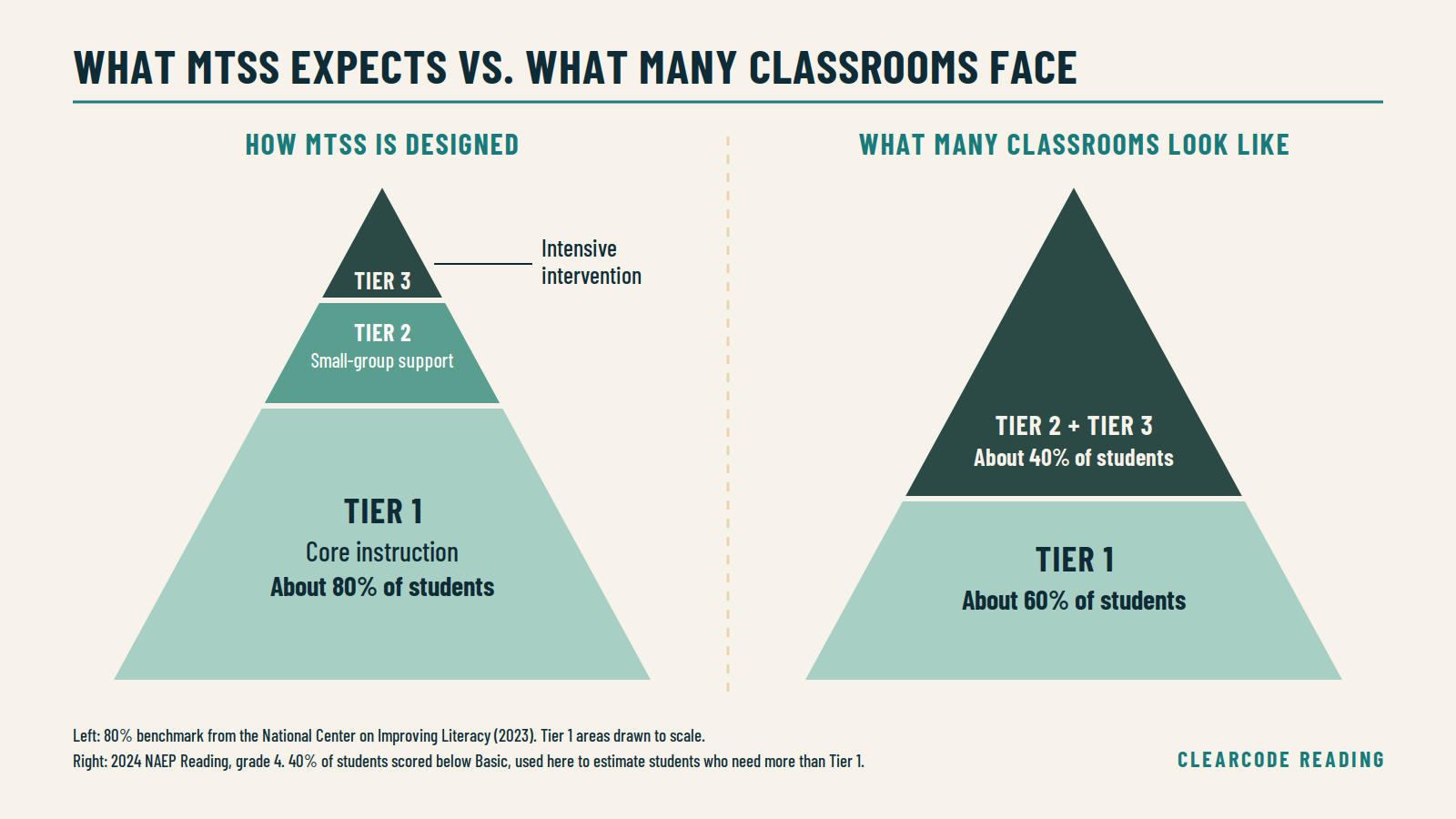
The MTSS model counts on most students, around 80%, doing fine with Tier 1 alone. The National Center on Improving Literacy’s school planning tool treats 80% or more on track at the start of the year as healthy, and flags a school as high priority when fewer than 60% are on track.⁹ High-quality Tier 1 instruction is the cornerstone of MTSS, as it should be. That’s because you can’t intervene your way out of a Tier 1 issue. If students aren’t consistently receiving high-quality grade-level instruction, the system will always be overwhelmed with students who need Tier 2 and Tier 3 support.
The reality in our schools is complicated. In a lot of schools, students don’t fall neatly into the MTSS triangle. Even in that federal study, where every school had years of experience running it, only 59% of first graders started the year in Tier 1.¹⁰ Schools are trying to get their Tier 1 instruction on track, and they still have a large number of students who need support right now because they haven’t received high-quality instruction in the past. A school could have 60% of students on grade level and the MTSS system for Tier 2 and Tier 3 support will still be overwhelmed. For each year I taught fourth grade, my class had more of an inverted triangle. The majority of my students needed additional support. Thankfully, we were able to provide this support in the classroom because we had an extended school day, but an 8:00 a.m. - 4:00 p.m. school day isn’t typical for most schools.
So even if the leader designs an assessment system that runs like a well-oiled machine, in a lot of schools the data will show that an overwhelming number of students need Tier 2 and Tier 3 support. In order for a leader to design a master schedule that allocates time for each tier of instruction across grades and subjects, they most likely would need to add hours to the day and have an interventionist on payroll for every grade level. Neither of those is in their control.
My second post in this series breaks down how many students across America need support with reading.
In my experience as a classroom teacher and district leader, I can’t say we implemented MTSS effectively. There were pockets where MTSS implementation was strong, but system-wide implementation was hard to sustain. I told you what we were supposed to do. But in reality, it didn’t really matter what we decided in the six-week data meeting because, like I said, the interventionist was already at capacity. The schools I worked in consistently had long-term teacher vacancies, which meant students weren’t getting high-quality Tier 1 instruction. To remedy this, school leaders would assign the reading interventionist classroom teacher duties. That meant the reading interventionist was subbing for first-grade ELA and couldn’t pull intervention groups. I made a plan to support our students with the Special Education teacher and the ELD teacher, and we closed our door and did what we could. Do more with less.
What most likely happens in these situations is that the students who have the most severe needs get the support, and the students who still need support get as much as their teacher can provide with the time and resources she has. And often, it’s not enough. The teacher knows it, the student knows it, and you know it. It sucks. I think it’s one of the reasons teachers get burned out and leave. It’s really hard to show up to work every day doing your best and knowing that it will never be enough.
What can parents do?
Your child’s teacher is most likely trying her best, but she might not have enough hours in the day to give your child the support they need. I know you already know that. And you are the one in their corner who can get them help. You know what’s best, and you are going to figure it out.
If you think your child needs support in reading, have a conversation with their teacher to see how you can create a plan to support them at school and at home.
Ask your child’s teacher whether your child needs support in foundational skills (like phonics) or comprehension, whether tutoring or reading intervention would help, and whether that support is offered during the school day.
If your child would benefit from reading intervention, but it’s not offered at the school, consider hiring a tutor or an interventionist. In my last blog post, I provided some questions you can ask potential tutors.
You also don’t have to wait for MTSS to run its course. If you think your child might have a learning disability, you can ask the school to evaluate them for special education. Federal guidance says schools can’t use MTSS to delay or deny that evaluation.¹¹ We’ll get into how that process works next week.
Visit our website. You can explore our free resources for parents and request a consultation. Someone from ClearCode will reach out to you and talk you through support options for your child. Our reading interventionists are currently accepting K–8 students in the Orlando area.
Endnotes
TNTP. (2018). The Opportunity Myth: What students can show us about how school is letting them down—and how to fix it. Five school systems (three urban districts, one rural district, one charter network), 2016–17 school year; nearly 4,000 students, about 1,000 observed lessons, nearly 5,000 assignments. Purposive sample, not nationally representative; teachers opted in. Findings on learning gains are associations from classroom-level models, not experimental estimates. “Grade-appropriate” is TNTP’s own rubric rating. TNTP is a consulting and advocacy organization as well as a research group. https://opportunitymyth.tntp.org/ ; Technical Appendix: https://tntp.org/wp-content/uploads/2023/02/TNTP-OppMyth_TechAppx_FINAL.pdf
Kraft, M. A., Blazar, D., & Hogan, D. (2018). The effect of teacher coaching on instruction and achievement: A meta-analysis of the causal evidence. Review of Educational Research, 88(4), 547–588. 60 studies with causal designs (56 randomized trials), mostly literacy coaching for pre-K and elementary teachers. Pooled effects: 0.49 SD on observed instruction and 0.18 SD on student achievement. Pairing coaching with group training was associated with effects 0.31 SD larger on instruction and 0.12 SD larger on achievement; the authors describe these feature comparisons as descriptive, not causal. Effects were smaller in larger programs (0.10 SD on achievement for programs with 100 or more teachers), and a statewide Florida reading-coach program in the sample showed very small effects. https://doi.org/10.3102/0034654318759268
Gersten, R., Compton, D., Connor, C. M., Dimino, J., Santoro, L., Linan-Thompson, S., & Tilly, W. D. (2009). Assisting students struggling with reading: Response to Intervention and multi-tier intervention in the primary grades (NCEE 2009-4045). Institute of Education Sciences, What Works Clearinghouse. Recommendation 3: Tier 2 groups meet three to five times a week for 20–40 minutes; evidence rated strong. Covers K–2 only. https://ies.ed.gov/ncee/wwc/Docs/PracticeGuide/rti_reading_pg_021809.pdf
Gersten et al. (2009), p. 5. The panel expresses the hope that RtI will reduce inappropriate referrals to special education, including for students who received weak reading instruction.
National Center on Improving Literacy. School MTSS-R Implementation Checklist, v. 4 (n.d.; accessed September 2026). Element I, items 45 (Tier III daily; total reading time exceeds what other students receive), 48 (delivered by intervention specialists, content specialists, or special education teachers), and 49 (groups of 2–3 or individual). Federally funded technical assistance tool (OESE/OSEP Award S283D160003), not a research study. https://docs.google.com/spreadsheets/d/15L7eyM_j0JXJpEpUQYeP6hDBCXOT0SFgyHiwaeuFmio/edit?gid=1651538610#gid=1651538610
American Institutes for Research, Center on Multi-Tiered System of Supports. (2025). School infrastructure and support mechanisms tip sheet: Schedule. Practice guidance, not a research study. https://mtss4success.org/sites/default/files/2022-02/MTSS_Schedules.pdf
Balu, R., Zhu, P., Doolittle, F., Schiller, E., Jenkins, J., & Gersten, R. (2015). Evaluation of Response to Intervention practices for elementary school reading (NCEE 2016-4000). Institute of Education Sciences. Impact sample: 146 schools in 13 states, 2011–12 school year. Regression discontinuity design; impact estimates apply only to students near their school’s eligibility cut point and do not assess whether RtI as a whole is effective. Grade 1 effect on a comprehensive reading measure: −0.17 SD. https://ies.ed.gov/pubsearch/pubsinfo.asp?pubid=NCEE20164000
Kim, J. S. (2019). Making every study count: Learning from replication failure to improve intervention research. Educational Researcher, 48(9), 599–607. https://doi.org/10.3102/0013189x19891428
National Center on Improving Literacy. (2023). Action plan. MTSS-R Implementation Guide. Health Indicator Table, beginning-of-year universal screening: more than 80% at low risk = low priority; 60–80% = moderate priority; under 60% = high priority. The tool does not cite a source for these thresholds. Federally funded (OESE/OSEP Award H283D210004). https://improvingliteracy.org/mtss-r-implementation-guide
Balu et al. (2015), Executive Summary, p. 9. Fall 2011 placements for Grade 1 in impact sample schools: 59% Tier 1, 25% Tier 2, 16% Tier 3.
U.S. Department of Education, Office of Special Education Programs. (2011, January 21). Memo 11-07: A Response to Intervention (RTI) process cannot be used to delay-deny an evaluation for eligibility under the Individuals with Disabilities Education Act (IDEA). https://sites.ed.gov/idea/idea-files/osep-memo-11-07-response-to-intervention-rti-memo/